Multiplication Game
Product Game is a classic game. Getting tired of playing it, so I made an upgraded version .
Infinite Games
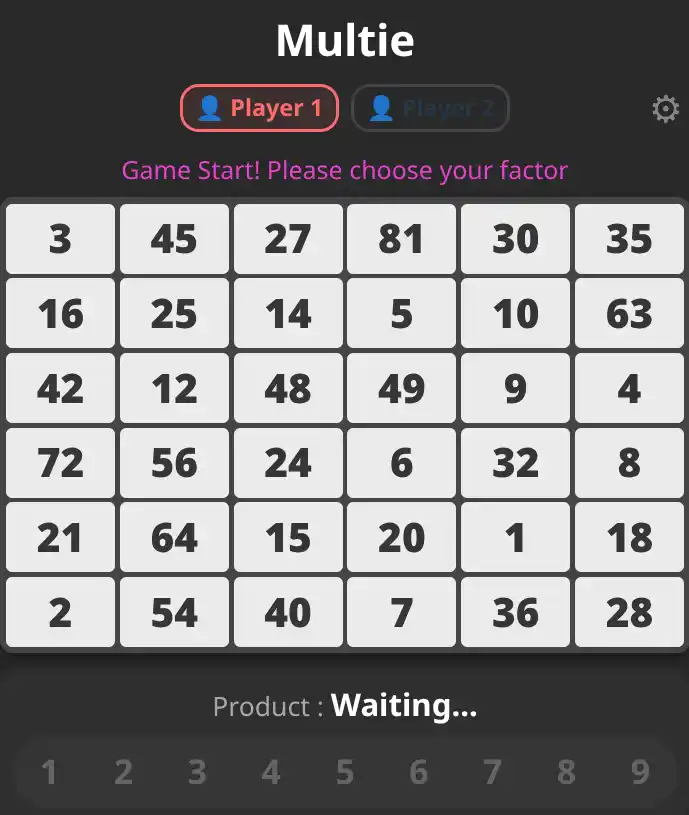
In the original version, the positions of all the products were fixed. Players quickly memorized the entire board—which products were more likely to appear, which positions were riskier, and which paths were easiest to connect. The game lost its appeal. So in the new version, I completely randomized the entire board. It may seem like a minor change, but it results in an exponential increase in the number of possible combinations.
For a \(6 \times 6\) board:
\[ 36! \approx 3.72 \times 10^{41} \]This is an incredibly staggering number. Even if we could test 1 billion permutations per second, the time required to exhaustively explore all possibilities would still far exceed the current age of the universe. A finite number of cells can give rise to nearly infinite variations through “permutation.” This is one of the most fascinating aspects of mathematics: the rules may be simple, but complexity emerges on its own.
AI Learns
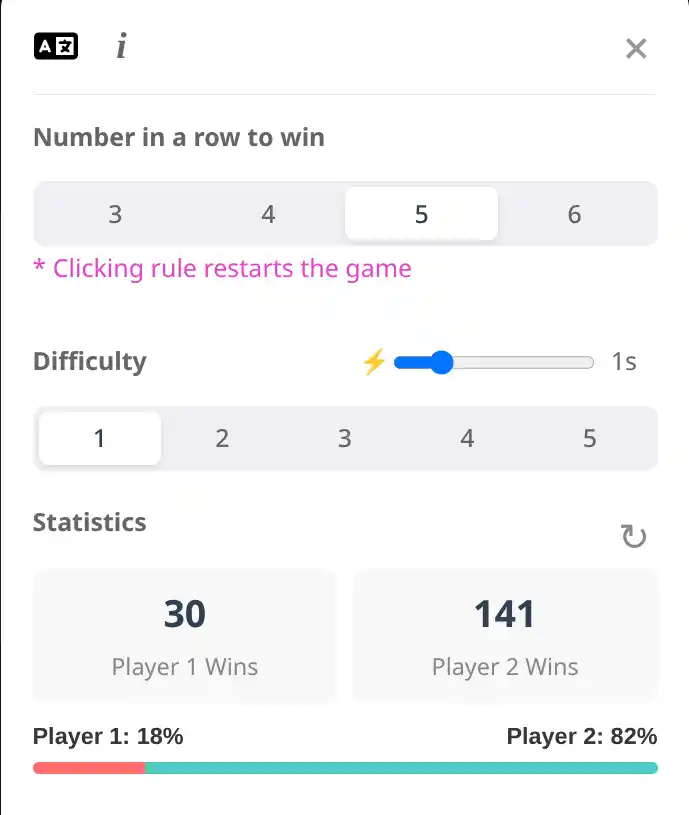
Later, the students complained that “the AI is too dumb.” So I began adding a bit of “thinking” to it. Lower-level AI behaves more like humans, randomly testing the waters and often making mistakes that lead to its own downfall; higher-level AI, on the other hand, starts calculating probabilities, competing for key paths, and blocking routes in advance. Eventually, I realized that the traditional approach of “searching a few steps ahead” wasn’t very effective. So I simply trained a very small neural network and let the AI learn on its own:
- Which positions are more dangerous?
- Which lines are more likely to form a chain?
- Which combinations of pieces will gradually gain control of the board?
Interestingly, even though it’s just a simple multiplication game, when the number of training examples is large enough, the AI gradually develops a certain “sense of the game.” Testing also revealed that the player moving second has a clear advantage.
AI vs. AI
Later on, many students no longer enjoyed playing the game themselves. Instead, they preferred watching two AIs play against each other ⚔️. Sometimes they would fiercely battle for control of the center, sometimes they would spend long periods blocking each other’s moves; occasionally, a “retreat to advance” strategy would even emerge.
They’re just a few numbers from the multiplication table, but when rules, randomness, and strategy are combined, the system gradually develops something resembling “intelligence.” This is also what I’ve always found so fascinating about mathematics:
Complexity does not necessarily require complex rules.
Further Reading