Making math visible.
Mathematics is so much more than workbooks and drills.
To many, math is synonymous with tedious calculations, rigid formulas, and high-pressure exams. Yet, as you peel back the layers, you discover that math isn’t really about numbers at all—it’s about the relationships, patterns, and structures that lie beneath them.
The beauty of thoughtfully designed games is that they often reveal these hidden patterns far more intuitively than repetitive exercises ever could. Below are a few digital playgrounds I frequently recommend to my students. Some feel like arcade classics, others like brain-teasing puzzles, and a few even carry the strategic depth of chess.
While they may look like simple games, they are actually fine-tuning the brain to spot patterns, forge relationships, and engage in logical reasoning.
TuxMath
This is a quintessential math arcade game, featuring Tux, the beloved Linux penguin.
Inspired by the classic arcade game Missile Command, the game challenges you to defend your city from a rain of “meteorites,” each emblazoned with a math problem. Only by typing the correct answer can you blast the meteorites out of the sky. In short: the sharper your mental math, the longer you survive.
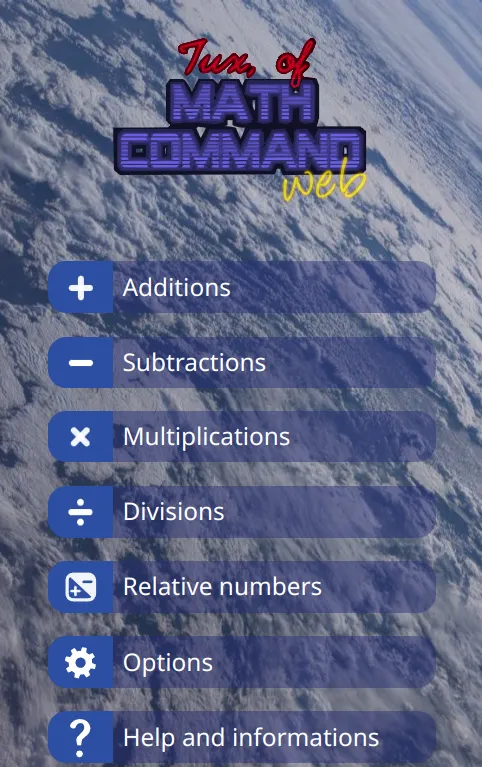
The game covers:
- Addition
- Subtraction
- Multiplication
- Division
- Negative numbers
With adjustable difficulty levels for every operation, it is the perfect training ground for students mastering arithmetic and sharpening their mental speed.
SolveMe Mobiles
A masterclass in elegant puzzle design.
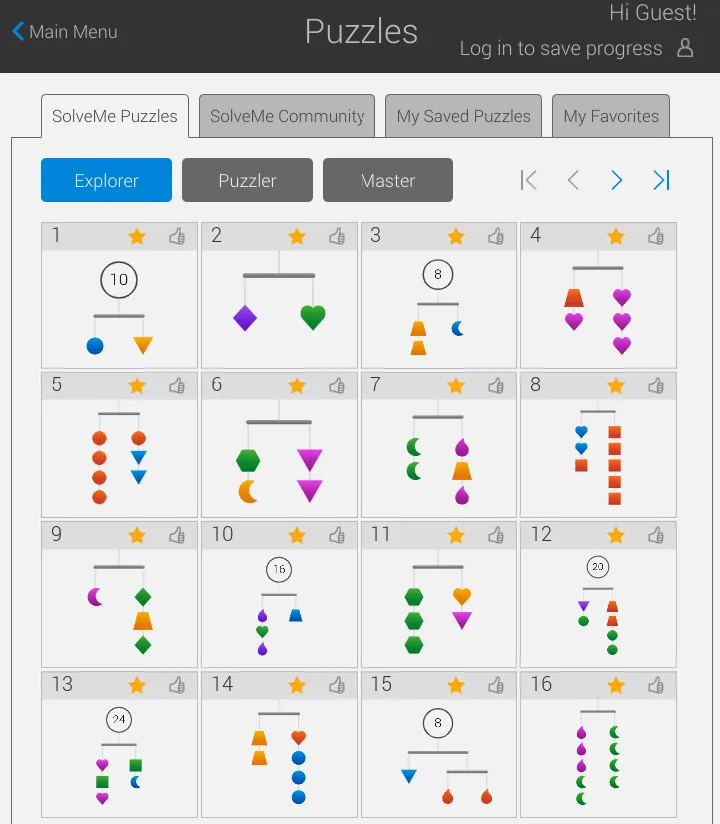
On screen, you are presented with a series of “mobiles”—hanging balances where various shapes represent specific, unknown weights. Your task is to observe how the structures tilt and sway to deduce the value of each individual piece.
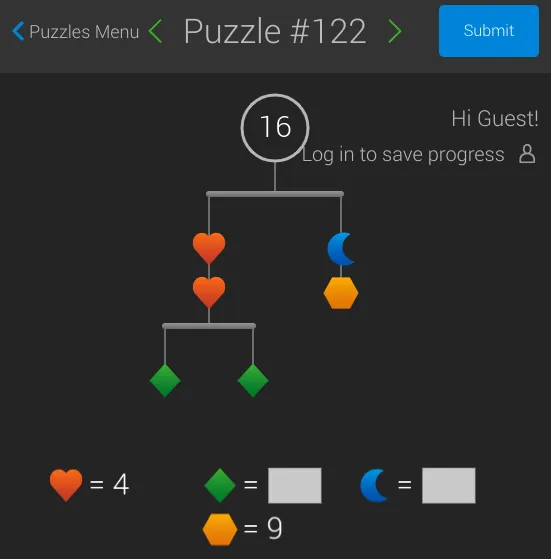
If the weights aren’t equal, the balance tips; every clue is baked directly into the visual structure.
While it presents itself as a simple balancing toy, it is essentially teaching:
- Creating equations
- Elimination methods
- Solving for unknowns
This is algebra in its purest form. The magic of algebra lies in the fact that we can understand the relationship between things without needing to know exactly what those things are. Many students are intimidated by the sudden appearance of variables, but they are merely placeholders—the true substance is the relationship itself.
Product Game
At first glance, this game plays much like a classic line-up strategy game (e.g., Connect Four). The rules are straightforward:
- Player A selects a factor.
- Player B selects a factor.
- The product of those two numbers is marked on the board.
The goal? Be the first to claim a line of four.
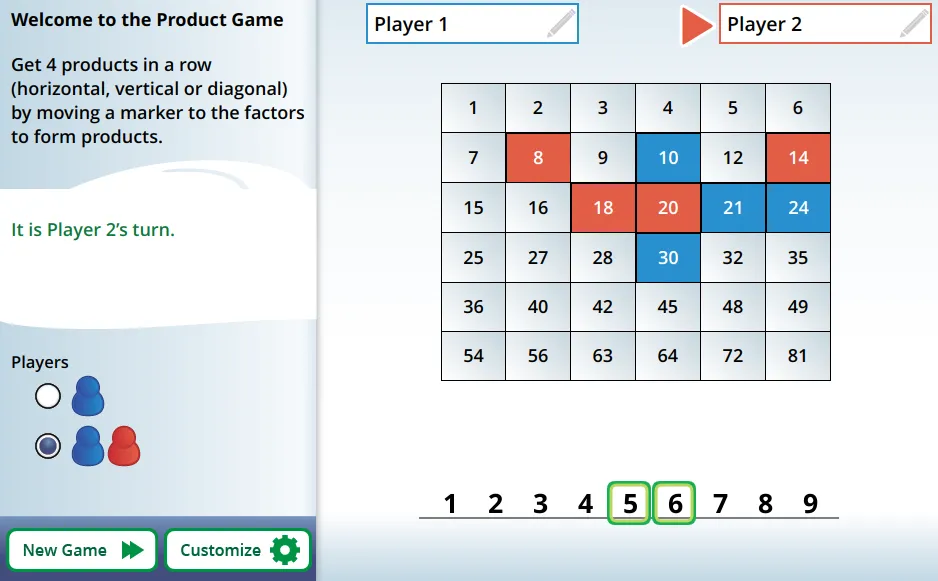
While it appears to be a drill for multiplication, the real depth lies in the strategy:
- Which products will you gift to your opponent?
- Which numbers on the board are the “high-value” pivot points?
- Do you play defensively to block, or offensively to win?
Whether playing against a friend or the computer, you aren’t just practicing multiplication; you are navigating a numerical network. Every move reshapes the landscape of future possibilities, mirroring the complexities of real-world decision-making—where one choice not only creates an immediate result but also fundamentally alters the space of what comes next.
Algebra Equations
Many students stumble when first encountering equations because the “rules” feel arbitrary:
- Why can I move terms around?
- Why must I perform the same operation on both sides?
- How can I be sure the answer remains valid?
View an equation as a balance scale, and these rules cease to be abstract mandates—they become physical necessities. Math isn’t about numbers; it’s about equilibrium. From elementary equations to university-level calculus, linear algebra, and even the laws of physics, we are constantly studying different manifestations of balance.
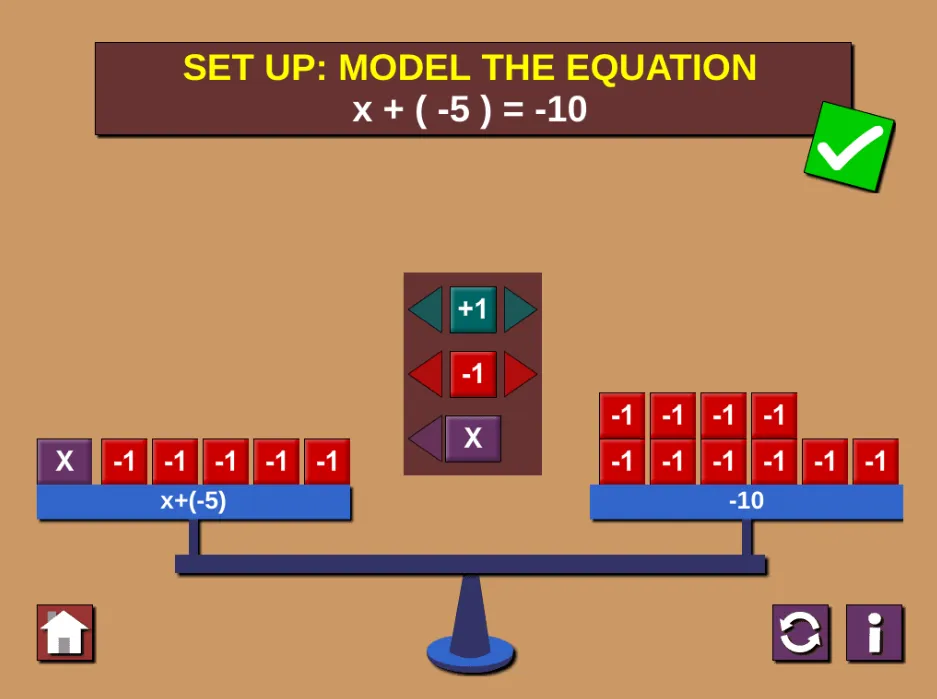
This game gamifies:
- Transposition
- Cancellation
- Solving for unknowns
By rendering these concepts visible, students intuitively grasp the why behind algebraic manipulation.
Balancing Scales
Operating on a similar principle, this activity demonstrates that if you remove a block from one side, the other side must be lightened identically to maintain equilibrium.
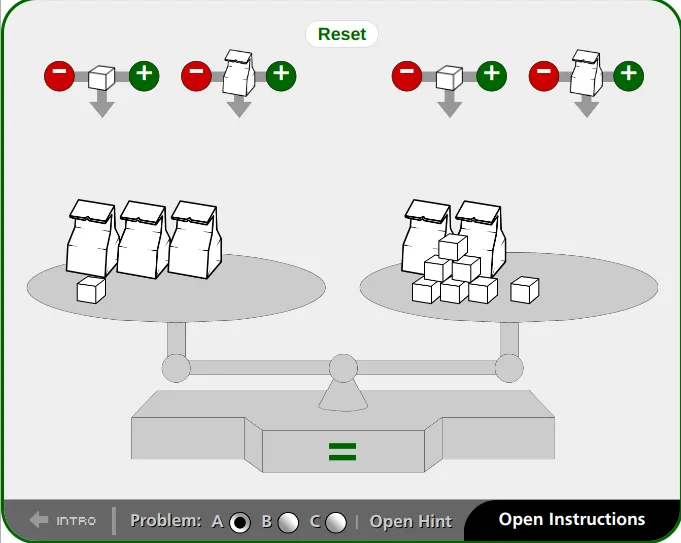
This illustrates the golden rule of algebra:
What you do to one side of an equation, you must do to the other to keep it balanced.
What feels abstract and confusing on a worksheet becomes crystal clear when modeled as a physical scale.
These games share a common virtue: they don’t make math “easier,” they make it visible.
When numbers, relationships, and structures are woven into the rules of a game, abstract concepts take on shape and form. The scale becomes the embodiment of an equation; the hanging structure becomes a map of algebra; the game board becomes a field of strategy and state space.
We often think we are simply learning about numbers, but in reality, we are cultivating a way to understand the world. We are learning to find patterns in apparent chaos, to discern structures within complex relationships, and to reason through the unknown.
Further Reading