Math is game.
Many people envision math practice as an austere ritual: a pen, a sheet of paper, a barrage of calculations, and a final check against the answer key. In reality, a great deal of mathematical dexterity can be cultivated almost imperceptibly through simple games. These games typically share a few defining traits:
- Elegant, straightforward rules
- A near-zero barrier to entry
- Immediate feedback loops
- Unambiguous objectives
- An addictive, “just one more round” quality
Here are a few more exceptional math games well worth exploring.
Bingo
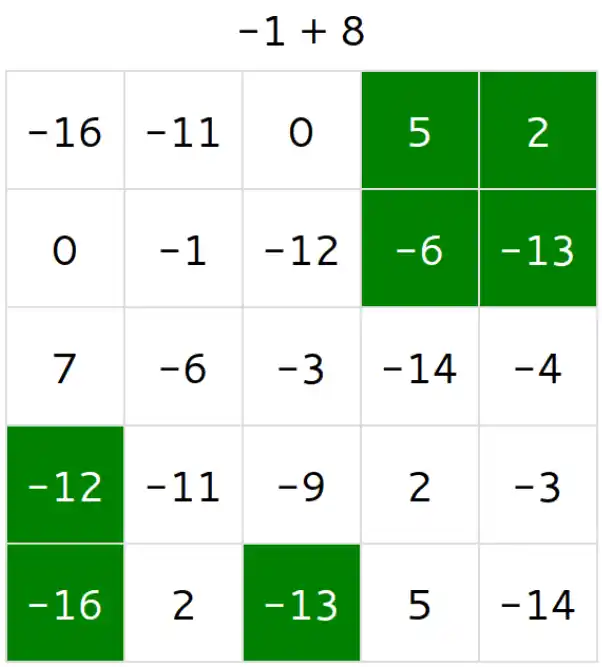
This mini-game breathes new life into integer arithmetic by blending it seamlessly with Bingo.
Players are presented with simple problems like these:
-7 + 5 = ?
8 - 12 = ?
Once you solve the equation, you locate the corresponding number on the board to claim that square, with the ultimate goal of being the first to complete a row.
So, what makes it so engaging?
When tackling arithmetic in isolation, it is easy to fall into a mechanical rhythm—mindlessly churning through one problem after another. However, the introduction of the game board completely shifts the dynamic, prompting a new question:
Which position should I claim first?
Suddenly, calculation transcends mere rote practice and becomes an element of strategic play. The underlying mathematics remains exactly the same, yet the simple addition of spatial layout and competitive goals transforms the entire experience.
Nerdle
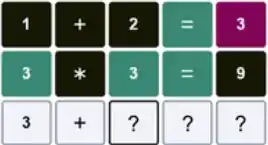
If you have ever played Wordle, Nerdle will feel instantly familiar. The twist here is that instead of guessing a word, you are searching for a mathematically correct equation. For example:
8 + 4 = 12
With each guess, the game provides feedback on which numbers and symbols are correct, and whether they are in the right position. You then use these clues to deduce the final answer.
What makes it so engaging?
The brilliance of the game lies in how it seamlessly blends calculation with logical deduction. The calculation aspect requires you to ensure the equation remains perfectly balanced. However, the real thrill comes from the deduction—using the feedback to systematically narrow down the possibilities:
- Are the numbers correct, or just in the wrong spot?
- Where is the equals sign hidden?
- Which mathematical operators are at play?
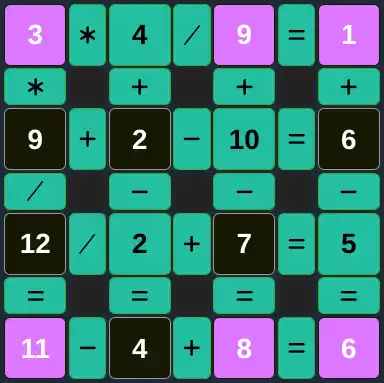
This gives the game the distinct feel of a puzzle or a detective investigation, transforming mathematics into a captivating game of information and logic.
Brain Teasers
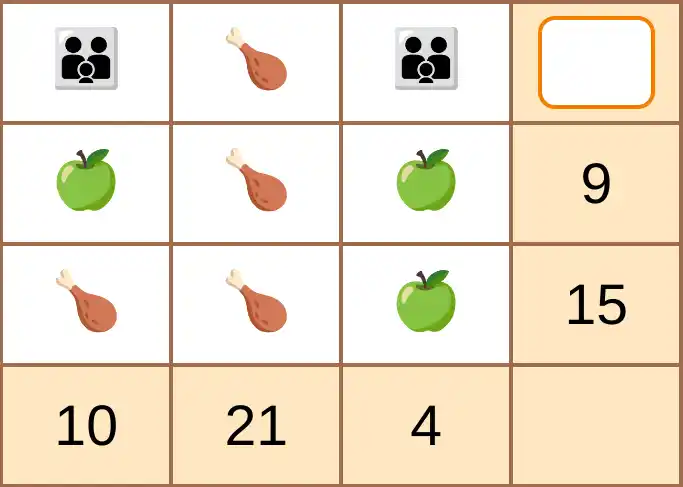
These puzzles are a staple of the internet, typically formatted like this:
🍏 + 🍏 + 🎃 = 20
🍏 + 🎃 = 14
The goal is to deduce the numerical value of each icon. In mathematical terms, you are simply solving a system of linear equations.
But why does this visual format captivate people so much more?
It works because the variables are grounded in reality.
For many beginners, letters like $x$, $y$, and $z$ feel abstract and detached. By replacing them with apples, pumpkins, or turkeys, the brain instantly forms a tangible connection. The task shifts from “solving an equation” to “discovering what each picture represents.” While the underlying mathematics remains exactly the same, the psychological experience is entirely transformed.
Psychology speaks of a concept known as “instant feedback.” When our actions yield immediate consequences, the brain remains effortlessly engaged. This is precisely where gaming excels: guess correctly, and you are instantly rewarded; falter in your calculations, and the error is immediately clear; progress is always visibly tracked.
In contrast, traditional exercises often demand we complete the entire set before receiving any validation. This delayed feedback dulls the sense of involvement. Math games do not necessarily simplify the math; rather, they accelerate the feedback loop and sharpen the objective.
Intriguingly, people will willingly lose hours to a single puzzle, yet balk at a mere ten minutes of repetitive drills, even when both exercises cultivate nearly identical skills. The divide lies not in the substance, but in the presentation.
When computation transforms into exploration, and deduction becomes a puzzle to solve, mathematics finally reveals its inherently captivating nature.
Further Reading