What we’re arguing about is what counts as an answer.
We often harbor the belief that truth resembles a mathematical absolute—profoundly elusive, yet inherently there. It comforts us to imagine that if humanity becomes sufficiently enlightened, possesses a wealth of information, commands vast computational power, and is granted the expanse of eternity, we might one day arrive at that singular “Ultimate Answer.”
Yet, as we strive to elevate our intellect, as we forge and unearth oceans of data, and even as we conjure artificial intelligence to quicken our pace, we find ourselves confronting a realization far more unsettling than the mere difficulty of the quest:
Reality itself may harbor no singular, ultimate truth to be found.
A Solitary Peak: The Classical Paradigm
Imagine standing upon a mountain ridge, driven by a single, unwavering purpose:
To descend ceaselessly, until you arrive at the absolute nadir of the earth.
This is the foundational archetype of “truth” that many implicitly live by:
- The universe holds objective answers.
- Ultimate truth is singular.
- Error is merely a transient shadow.
- Divergence is nothing more than a scarcity of light.
Within this landscape:
Truth is the global minimum—the one true valley at the base of the mountain.
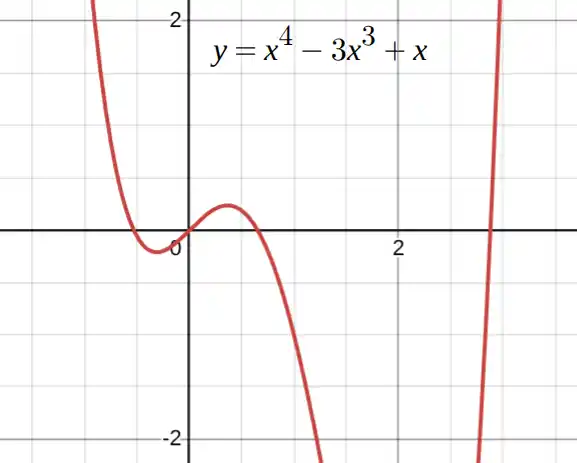
Your only directive is the continuous optimization of perception, mapping the steepest descent. It mimics the refinement of an artificial intelligence: as the loss diminishes, the model approaches perfection. In principle, granting optimal conditions, a definitive global minimum must exist—a destination inevitable. It is an optimization problem bound to a singular, observable, and immutable landscape.
The First Collapse: The Hidden Mass
Yet, reality soon brings the first reckoning:
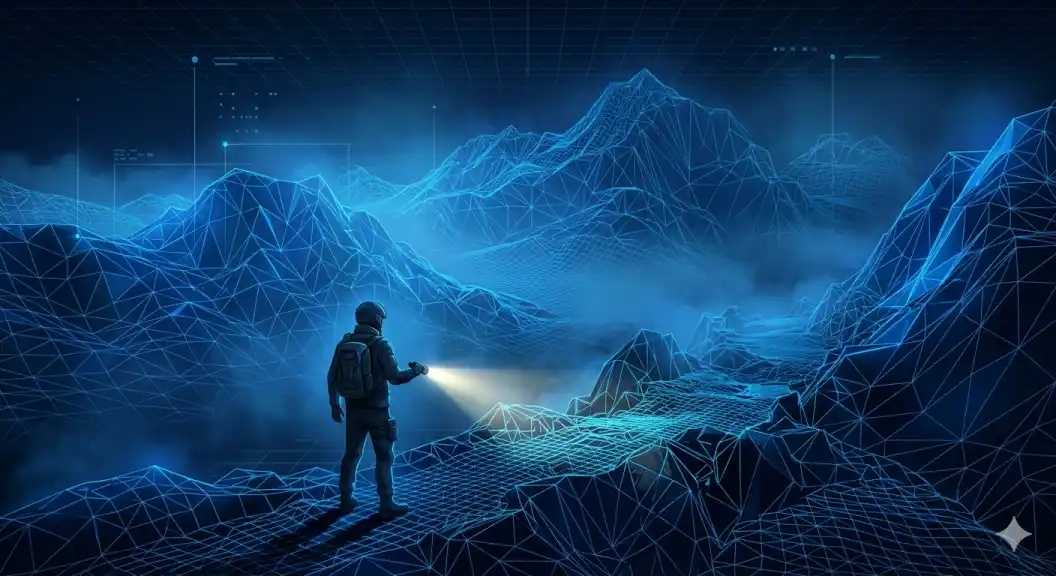
You are blind to the horizon, stranded on a solitary patch of earth.
You awaken to a stark clarity:
- You are indeed descending.
- Yet whether a deeper abyss lies beyond the mist remains unknown.
- You cannot even ascertain if you have merely stumbled into a fleeting hollow.
Here lies the perennial crucible of optimization.
You cannot discern whether you have reached the bedrock of existence or merely paused upon a transient plateau within some vast, unseen architecture. You believe yourself “near the truth,” when you are merely captive to a local optimum. And so, for the first time, the quest for ultimate truth loses its horizon.
In AI training, there is at least a quantifiable loss function to guide the way. Yet in the architecture of a human life, clarity vanishes:
- Does an accumulation of wealth truly signify ascent?
- Does the mitigation of suffering inherent to growth mean progress?
- Does absolute safety equal a life well-lived?
More often than not, you cannot discern whether you are locked in a steady descent, or if you have simply grown numb to the perception of altitude. And you will never possess the proof to declare:
I have finally touched rock bottom.
The very pursuit of truth begins to lose its verifiability.
The Second Collapse: The Shifting Terrain
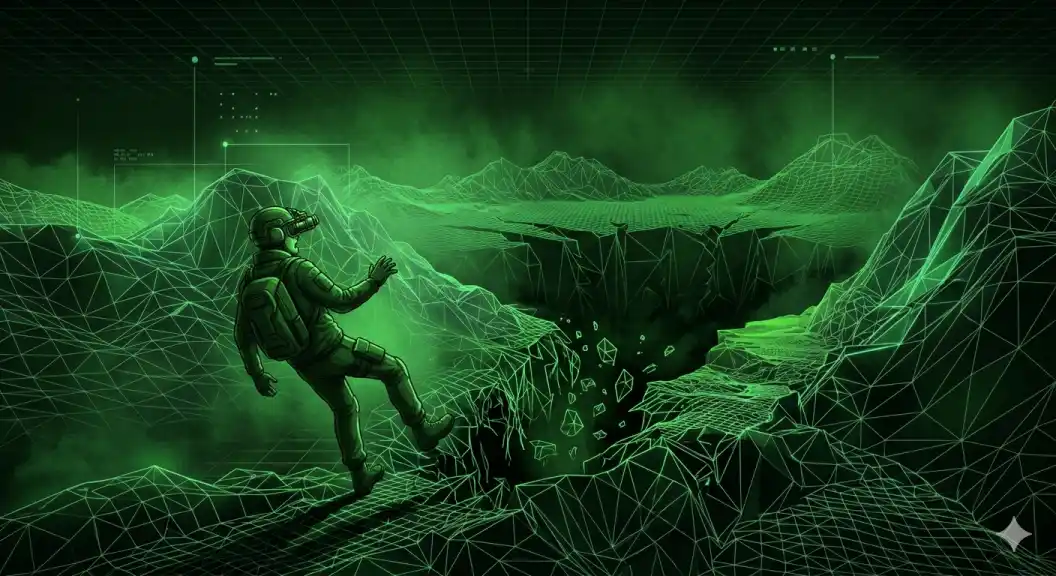
Suddenly, you realize the mountain was never a static monument, nor were you ever a mere observer. With every step you take, the earth gives way beneath your weight. If you slip on night-vision goggles, what was once a valley morphs into a peak. Alter your metrics, and the entire landscape reshapes itself.
In the past, perhaps you held a singular conviction:
“Success” is the relentless maximization of wealth.
Driven by this metric, you descended along that chosen path. Yet, there comes a moment of profound reckoning, a re-evaluation of what truly endures:
- The currency of time
- The sanctuary of health
- The warmth of kinship
- The vastness of spiritual freedom
In an instant, the valleys of your past become the new highlands; the inner topography is fundamentally rewritten. When you alter your instruments of measurement, the very nature of the incline shifts.
Thus, the question is no longer whether you can reach the ultimate nadir, but rather:
What truly defines the depth?
In different evaluation functions, distinct terrains are born. In the realm of mathematics, this is akin to altering the loss function. The moment the loss shifts, the global minimum vanishes, migrates, and completely reconfigures itself. You find yourself chasing a moving target within a constantly warping coordinate system.
Perhaps it is not that we have yet to discover the lowest point, but rather that the concept of the “lowest” is itself fluid. Here, “Truth”—the global minimum—forfeits its very meaning.
The Third Collapse: It Was Never a Mountain
The deeper complication is not that the mountain changes, but that reality is not a mountain at all. It resembles, instead, an overlay of multiple mountain ranges—overlapping, yet forever impossible to merge.
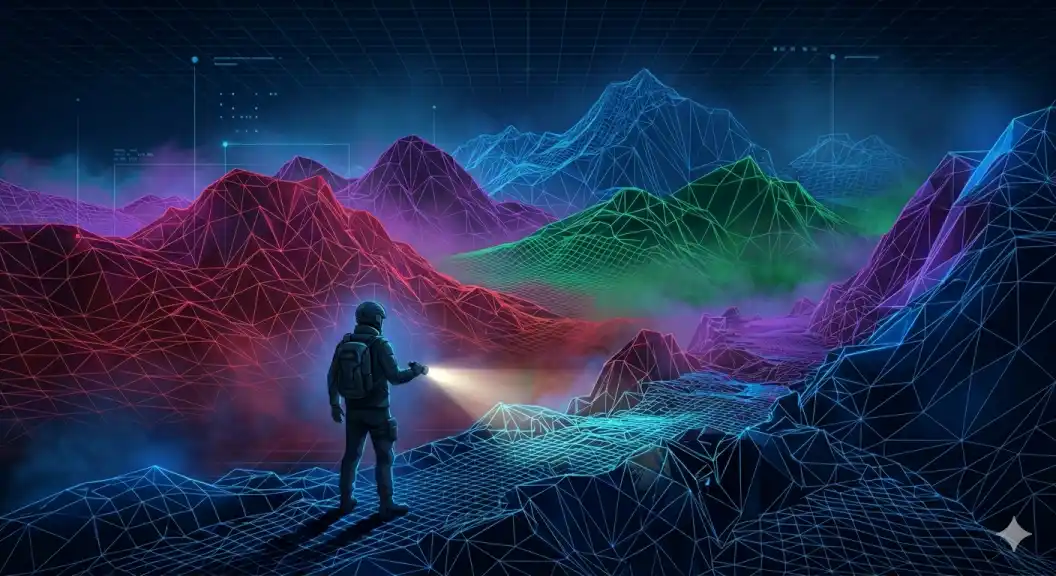
You exist simultaneously across a multitude of distinct realms:
- The Emotional Realm, where descending to the depths yields the greatest sense of sanctuary.
- The Social Realm, where hitting a low point means the burdens of the world fall away.
- The Rational Realm, where narrowing the baseline minimizes the errors of explanation.
- The Moral Realm, where keeping a low profile ensures the least amount of harm is done.
The inherent conflict is that they share no unified coordinates. To descend into the valley of emotion may mean ascending the steep peaks of reason. What is flawless in logic can be devastatingly cruel in morality. Achieving the ultimate equilibrium within society might mean asphyxiating your inner spirit. No higher arbiter exists to reconcile these disparate domains. You cannot define a universal “global” across these systems, for
a global truth can only exist when every dimension can be contained within the very same space.
This is not a matter of striking a balance—allotting sixty percent to reason and forty to emotion. Rather, they elude the same scale of measurement entirely. One cannot deduce whether a single measure of truth equates to a single measure of bliss, or if a fraction of freedom is worth trading for a fraction of security. They do not merely differ in quantity; they belong to inherently incompatible dimensions.
The so-called “midlife crisis” is rarely a consequence of failure. Instead, it is the jarring realization that you are existing simultaneously across multiple, unmappable terrains. Within the matrix of worldly achievement, you may well be approaching your global minimum of cost and maximum of return, ascending the peaks of conventional success. Yet, on the coordinates of vital essence, you might find yourself adrift on a flatline with no sign of rebound, moving through days like the living dead. The modern torment stems not from choosing the wrong path, but from being pulled apart by disparate maps—where the creator of each domain refuses to bow to the other.
The ultimate quagmire of human cognition is perhaps not our inability to find truth, but our stubborn illusion that all questions answer to a singular metric of judgment. Thus, we expend ourselves debating who holds the higher ground, who inches closer to the absolute. We fail to see that the disputants are not even climbing the same mountain.
What we call “local truth” is not a fragmented piece of some grand, ultimate reality. It is merely a transient, stable trough within a specific, closed system. It holds firm within its own architecture, only to fracture upon crossing into another—revealing itself, from a different dimension, to be entirely inverted.
The Illusion of “Ultimate Truth”
The elusiveness of an “ultimate truth” is not a matter of its profound obscurity, a deficit of data, or the fleeting nature of time. It remains forever out of reach for a far more fundamental reason:
The very concept of an “ultimate truth” presupposes the existence of a singular, all-encompassing loss function.
Such a function would need to weigh emotion, reason, morality, society, and meaning all at once, mapping them onto a solitary, universal coordinate system. Yet, reality offers no such unifying metric. Our actual existence resembles a wanderer caught between disparate, incompatible mountain ranges, perpetually shifting our perception of what it means to move downward.
Even should artificial intelligence come to possess information, computational power, and reasoning capabilities that dwarf our own, it will remain inherently incapable of delivering that “final answer.” The impasse is not a shortage of calculation, but a void in the fabric of reality itself.
Humanity does not clash over the “answers” themselves, but over the very nature of what is allowed to be one. Never we have been optimizing for the same world.
The Inherent Fragility of Understanding
Perhaps the deepest fractures between us stem not from a scarcity of shared information, but from a persistent, unspoken illusion: that we are all scaling the exact same peak. Under this assumption, we readily dismiss the actions of others as blindness, irrationality, or moral failure. Yet more often than not, they are simply navigating an entirely different topography.
The true burden of understanding is not to vindicate one’s own path, but to awaken to a profound realization:
The mountain beneath their feet may not be your mountain at all.
Further Reading