Human mind can never truly grasp the boundless tapestry of reality.
To comprehend existence, we must first condense it
The density of information inherent in the cosmos vastly outstrips the processing bandwidth of the human mind. To truly grasp a singular event in its absolute entirety demands that we simultaneously unravel its history, its architecture, its emotional resonance, its underlying impulses, its web of relationships, and the shifting trajectories of its future. In reality, such an expansive computation remains forever beyond our reach.
Thus, human cognition was never designed to mirror the world in all its intricate completeness. Instead, it was optimized for an entirely different endeavor:
To distill from finite time and bounded reason a decision that is simply enough.

This implies that the dawn of cognition begins not with comprehension, but with compression. We condense the intricate tapestry of reality into stark, singular symbols:
- “The Virtuous / The Malicious”
- “Triumph / Defeat”
- “Reason / Sentiment”
- “Liberty / Tyranny”
- “Eros / Philia / Storge” — Love in its fractured forms
These constructs we call “labels” do not truly describe existence; they are merely low-dimensional approximations of a boundless reality. Yet, the justification for their being is absolute:
Without compression, we would be reduced to eternal silence.
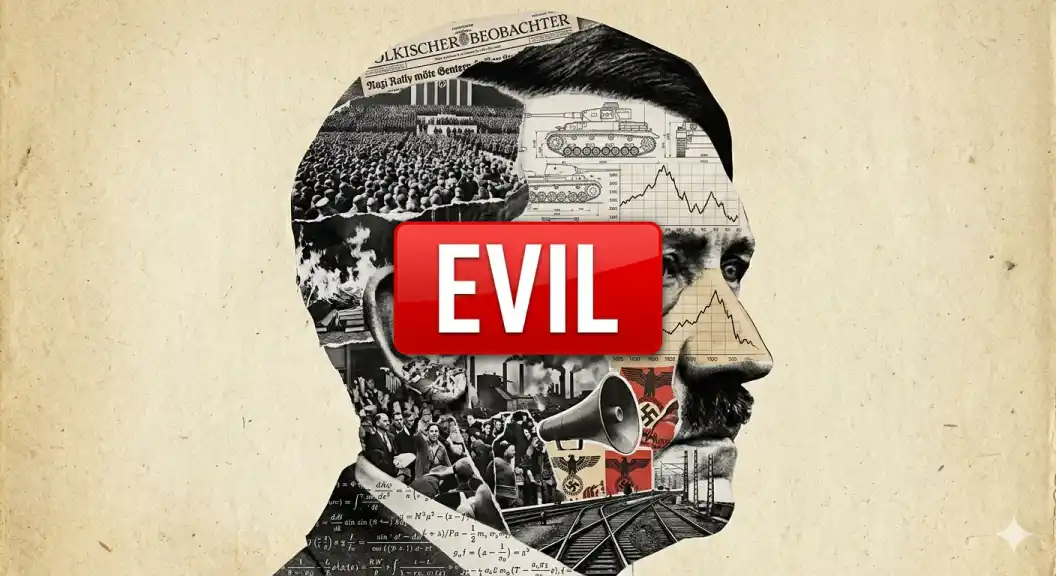
The figure of Adolf Hitler serves as a quintessential study in “cognitive compression.” Within the collective consciousness, this vast historical phenomenon has been distilled into a singular, reductive equation:
Hitler = Evil
Yet, the architecture of historical reality spans dimensions far more intricate: the fractured ruin of post-WWI Germany, catastrophic economic collapse, the virulent rise of nationalism, the calculated precision of propaganda, mass psychology, industrial mobilization, pioneering social welfare policies, absolute totalitarian dominion, and systematic genocide. This is not an exercise in absolution. Rather, it is an acknowledgment that the word “evil” fails to encompass such formidable complexity; it is merely an informational shadow, a low-resolution compression of history.
The Cost of Compression: We See Only the Projection
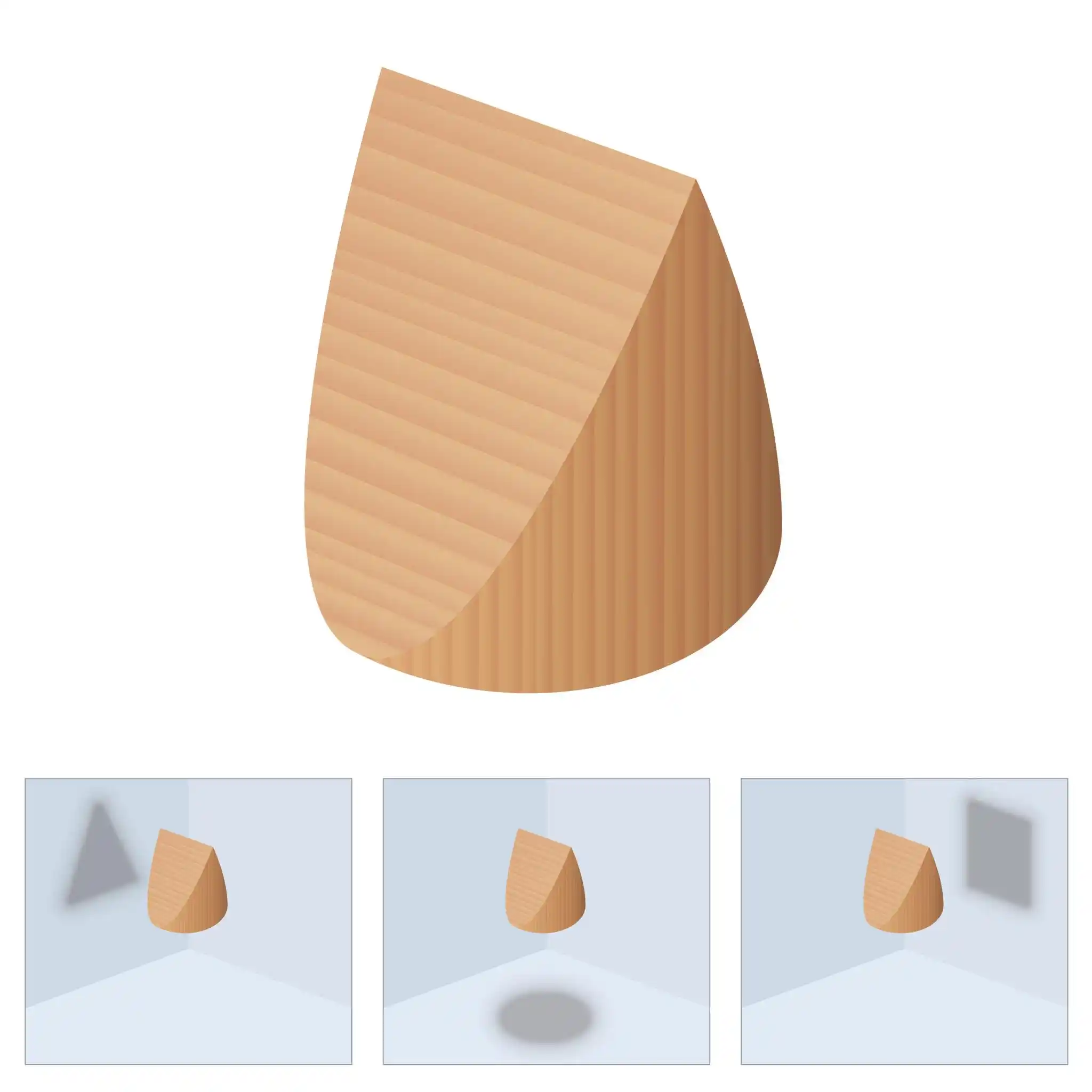
Any compression inevitably yields a loss of information. When a three-dimensional entity is projected onto a two-dimensional plane, depth is surrendered. Depending on the vantage point, the same object will manifest as entirely disparate projections.
Cognition functions no differently. Reality exists as a profoundly complex, multi-dimensional structure, yet we are confined to perceiving it through a limited set of dimensions. Consequently, we never truly behold the “object in itself”; instead, we witness:
The projection of the object within the space of our own cognition.
Thus, the same individual can be compressed across different contexts into:
- “Rationality” or “Indifference”
- “Steadfastness” or “Bigotry”
- “Freedom” or “Chaos”
The friction between these labels does not necessarily stem from a fundamental contradiction in reality, but rather from the varied angles of compression. The tragedy lies not in the act of compression itself, but in a subtle, pervasive cognitive fallacy:
We habitually forget that labels are merely projections, mistakenly perceiving the shadow to be the entirety of reality.
The Art of Compression
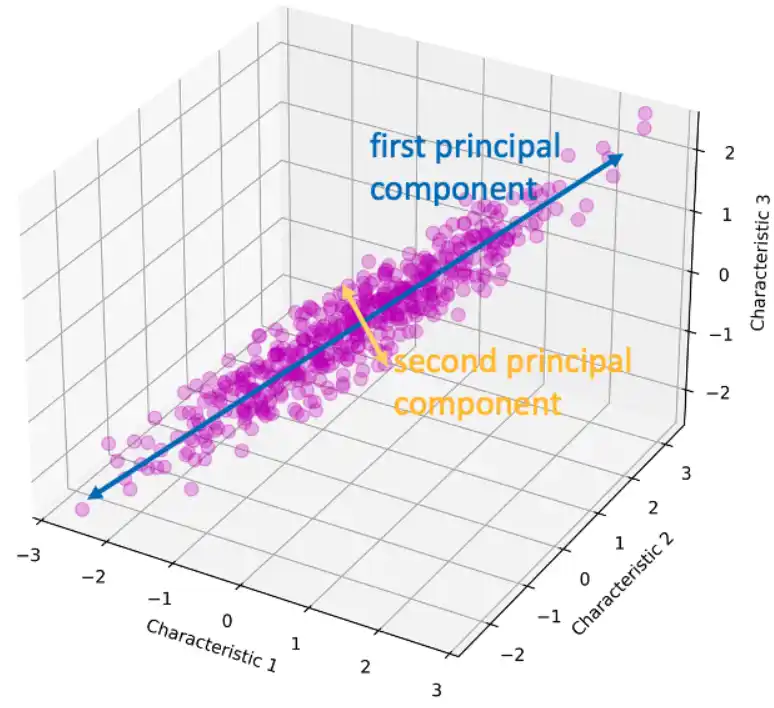
In machine learning, there exists a seminal dimensionality reduction algorithm known as Principal Component Analysis (PCA). When confronted with datasets spanning hundreds or thousands of dimensions, silicon processors, much like the human psyche, succumb to the “curse of dimensionality.” To achieve computational elegance and efficiency, the core logic of PCA is a sacrifice: it discards the peripheral and the marginal, distilling the chaotic expanse into Principal Components—those vital axes that capture the greatest variance and essence of the data.
The human cognitive system is, in many ways, a biological analogue—a dimensionality reduction algorithm honed over millions of years of evolution. The physical reality we inhabit is infinitely high-dimensional. A single person, a fleeting relationship, or a complex social upheaval is woven from an inextricable web of history, environment, temperament, and hidden incentives. Yet, under the unrelenting pressure of survival and the need for rapid volition, we cannot process the totality of being. We are compelled to compress high-dimensional reality into low-dimensional models. This is the quintessence of cognitive reduction.
Labels are the “First Principal Components” we extract from the noise. Imagine a silhouette lunging toward you from the shadows. To discern friend from foe in a heartbeat, the mind ignores the nuance of the soul and seizes upon the most salient dimension: the glint of a blade.
The Evolutionary Necessity of Labeling
If we conceptualize the cognitive process as a Discriminative Model, the fundamental inquiry shifts to:
How might one discern the essence of things with maximal precision, yet minimal input?
Faced with an inexorable deluge of data, simplification becomes a biological imperative. Labels are the fruit of this reduction—not merely a “summation of experience,” but the a priori architecture required for rapid inference. For instance:
- When gauging an individual’s trustworthiness, you are not computing the sum of their historical conduct; you are employing a compressed model.
- When distinguishing peril from sanctuary, you do not reconstruct the totality of environmental variables; you activate a high-speed classifier.
The utility of the label lies in its ability to truncate computational complexity, allowing the system to arrive at an “optimal-enough” conclusion within a finite window. In other essence:
Labeling is not a methodology for understanding the world; it is a defense mechanism against a collapse into its infinite complexity.
How Compression Supplants Reality
When a system relies indefinitely upon compressed models, a subtle shift occurs: the model begins to dictate perception, rather than perception refining the model. Humanity, in turn, begins to adapt inversely to its own taxonomies:
- Conduct deemed “success” is reinforced.
- Conduct branded “failure” is suppressed.
- Individuals cast into “categories” gradually conform to the very molds they were assigned.
Labels cease to be mere descriptive instruments; they ossify into architectures of behavioral constraint. The ultimate consequence is a world slowly narrowing to fit the confines of our own abstractions. We do not merely employ labels—we gradually inhabit them.
Beyond Understanding: The Predictive Mind
If the human cognitive architecture is not an “interpretive system” but rather a perpetually refining predictive engine (or a Generative Model), then its singular, relentless pursuit is this:
To architect an internal world-model that renders the future predictable.
We do not absorb sensory input from the universe simply to “witness what has occurred.” Instead, we ingest data to recalibrate an inner lattice, ensuring that our next leap into the unknown is more precise. In this light:
- Labels are but streamlined variables within the model.
- Categories serve as scaffolds designed to compress the chaos of future uncertainty.
- Cognition becomes the ceaseless labor of reconciling and minimizing predictive error.
Thus, to “understand” another soul is never to reconstruct the staggering totality of their detail. Rather, it is:
To achieve a state within a compressed model where their future essence becomes sufficiently foreseeable.

Reality flows in a seamless continuum, yet human cognition demands boundaries. A person’s motives are often a tangled, shifting web of contradictions; we rarely describe someone as “fluctuating between good and evil.” Instead, our minds instinctively gravitate toward binary anchors:
- The noble versus the malicious
- Triumph versus defeat
- Reason versus raw emotion
The truth is, processing a continuous world is computationally exhausting, rendering swift prediction nearly impossible within a fleeting moment. To cope, the cognitive system introduces artificial fractures—carving the infinite spectrum into finite categories. These boundaries are not the fabric of reality itself, but structured scaffolding designed to accelerate mental convergence.
A fluid world paralyzes decision-making; only discrete labels can ignite action.
- “His motives are intricate and layered” — incites hesitation.
- “Danger” — triggers immediate survival.
Over time, as this system of classification solidifies, we fall into the illusion that the universe was born of these very categories. Yet the truth is quite the opposite: the world has not conformed to our labels; rather, we have forbidden ourselves from seeing anything beyond what those labels can define. Reality remains as unfathomably complex as ever, but through relentless compression, we have chosen to inhabit a world built entirely of symbols.
Labels: A Structural Destiny, Not a Cognitive Flaw
The taxonomy of labels is no defect of the mind; it is a structural destiny. Bound by the scarcity of time, intellect, and data, humanity is compelled to forge a functional model of existence. Yet, the price of this architecture is our near-total captivity within our own methods of reduction. We reside in a paradox: we subsist upon labels, even as they bound the horizon of our understanding.
When a multi-dimensional soul is condensed into a flat, singular label, the discarded fragments of her being—her fragility, her quiet struggles, her unspoken compromises, and the shifting tides of her world—silently vanish from the theater of our consciousness.

Further Reading