Reconstructing the whole from the infinitude of the part.
A student tagged me with a frantic plea:
“Chad, what does this question even mean? 😨😨😨
What on earth is a cross-section?”
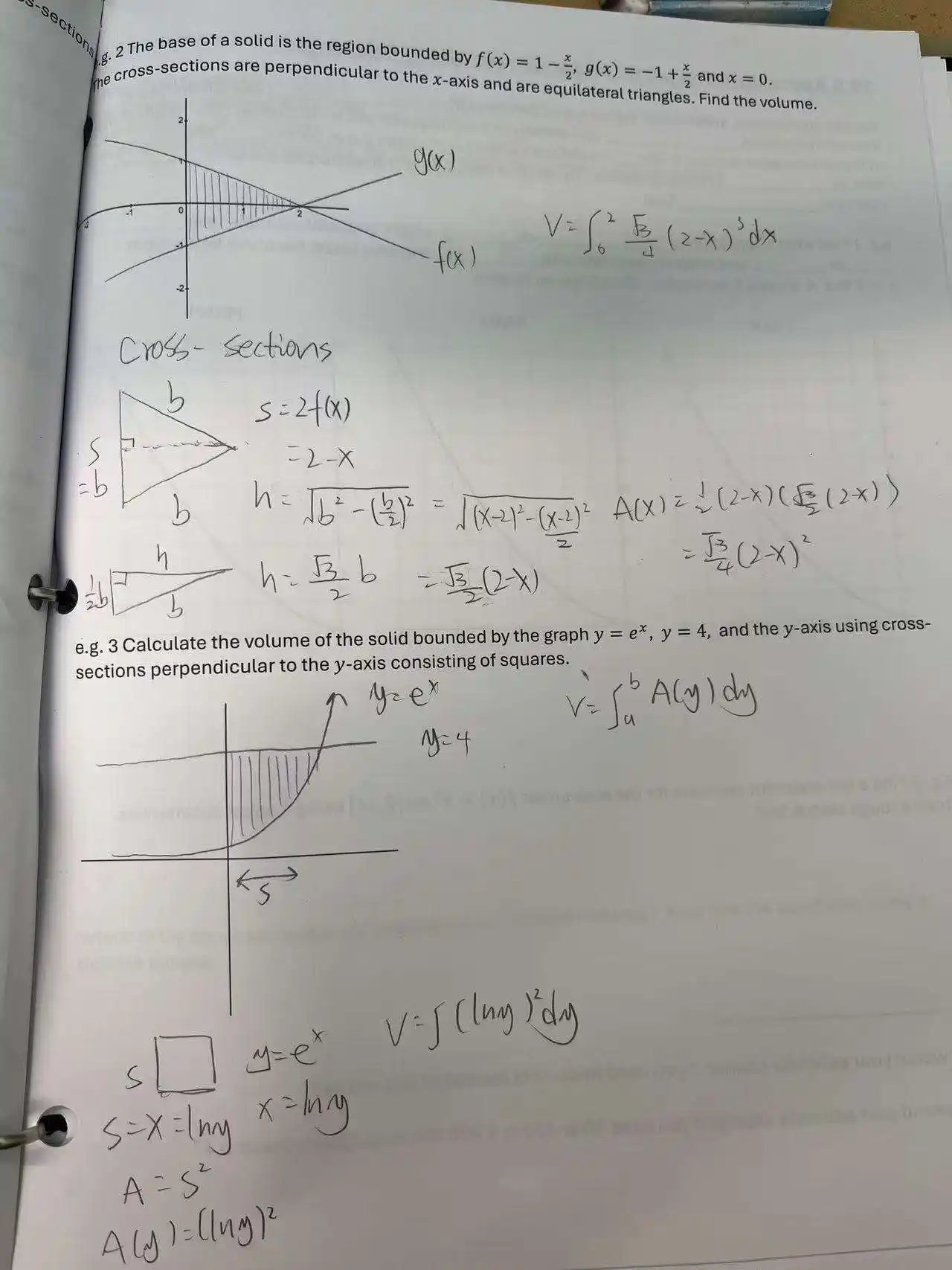
Her notebook was actually immaculate—not a single formula or step was missing. Yet, her struggle represents a classic dilemma: a lack of intuitive understanding. What are we truly doing when we “use integration to calculate volume”?
The Essence of Calculus
When navigating the complexities of volume in calculus, many stumble upon a particularly daunting challenge:
Determining the volume of a solid given its base and the geometry of its cross-sections.
Faced with a void of ready-made formulas, one often struggles to visualize the form or construct the governing expression under exam pressure. Yet, the foundational philosophy of integration is elegant in its simplicity: it is the art of deconstructing a grand, continuous whole into an infinity of infinitesimal fragments, only to weave them back together into a unified existence.
Starting from a single slice
Imagine you are in a kitchen, cutting a long loaf of bread.
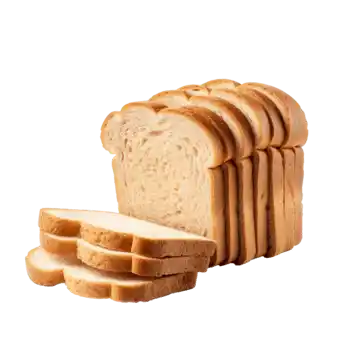
- Every cross-section yields a distinct surface area, captured as $A(x)$.
- Every slice possesses an infinitesimally subtle thickness, whispered as $dx$.
- Thus, the volume of a solitary slice is born from the union of space and depth: $A(x) \cdot dx$.
When these scattered slices are gathered and stacked as one, the full shape of the loaf is restored. In the language of calculus, we merely summon the integration sign $\int$ to weave these countless fragments back together:
$$V = \int A(x) \, dx$$As your blade cuts finer and finer, an infinity of slices—each carrying an almost imperceptible weight of existence—recreates the unbroken whole. It is the art of summoning the infinite from the infinitesimal, rebuilding a continuous world from nothing but thresholds.
Step One: Discerning the Base
Within these geometric problems, the “base” manifests as a bounded realm, quietly carved out by the intersection of a few defining functions.
Consider example 2, as woven into the accompanying illustration.
$f(x) = 1 - \frac{x}{2}$
$g(x) = -1 + \frac{x}{2}$
These two functions form a triangular base between $x=0$ and $x=2$—the very foundation upon which our solid will be built. Now, imagine taking a blade and slicing through this geometric footprint from left to right.
- Each slice cuts perpendicular to the x-axis.
- Each cut reveals not a mere line, but a fully formed cross-sectional shape.
As specified by the problem, every cross-section sliced this way forms an equilateral triangle.
Integration is akin to a two-dimensional scan, a process of reconstructing a three-dimensional entity. Much like a CT or MRI scan, the full solidity of the object is never captured all at once; rather, it is meticulously summoned into being, layer by delicate layer.
Step Two: The Measure of the Blade
The “length” of this singular cut is, in essence, the upper function in the $xy$-plane diminishing the lower—the subtle space mapping the distance between the two functions.
$s = f(x) - g(x)$
第三步:确定截面(The Cross-section)
The text will tell you the shape of the cross-section—be it an equilateral triangle, a square, or a semicircle. The conceptual hurdle most struggle to clear is this: these shapes do not lie flat; they rise vertically, “standing” perpendicular to the plane of the page.
- The Geometry of the Cross-Section ($Area$): Once the base length $s$ is defined by the boundaries, the corresponding area flows naturally from its geometric form:
- For a square: $A(x) = s^2$
- For an equilateral triangle: $A(x) = \frac{\sqrt{3}}{4}s^2$
As you erect these triangles or squares one after another along the path of the base, a three-dimensional solid begins to crystallize, much like the sweeping canopy of a tent. The visualization below brings this architecture into relief:

Translating Geometry into Functions
This is the pivotal juncture where spatial geometry transforms into the language of functions.
Taking Exercise 2 from the illustration as our anchor:
- Defining the Base $s$
$s = (1 - \frac{x}{2}) - (-1 + \frac{x}{2}) = 2 - x$
- To determine the cross-sectional area, $A(x)$, we invoke the elegant symmetry of the equilateral triangle, where the relations of the sides unfold effortlessly through the Pythagorean theorem or the language of trigonometry.
$A(x) = \frac{\sqrt{3}}{4}s^2 = \frac{\sqrt{3}}{4}(2-x)^2$
Regathering the Fragments Into the Whole
The volume of each infinitesimal slice is now known as
\[ dV=A(x)\,dx \]Thus, the total volume of the solid is expressed as
$V = \int_{0}^{2} \frac{\sqrt{3}}{4}(2-x)^2 \, dx$
Integration is never a formula conjured from a vacuum. It is, in its truest sense, the act of calculating each fleeting cross-section, and then weaving those scattered slices back into the completeness of the whole.
The Essence of Integration
A continuous universe can be reimagined, forged anew from an infinity of infinitesimal fragments. Nature itself flows in unbroken, seamless transition—and integration is simply the language humanity conceived to articulate this eternal continuity.