Debug
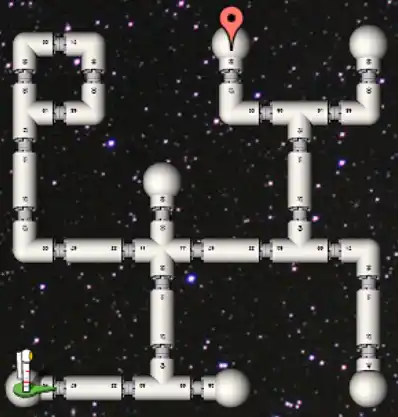
On the surface, it is merely a game of finding one’s way through a maze. Yet, beneath the playful facade lies the cultivation of a profound cognitive faculty:
The art of translating the nebulous whispers of intuition into a structured, executable choreography of reality.
From Tacit Knowledge to Shared Wisdom
Players are tasked with arranging various command modules:
- Move forward
- Pivot left
- Pivot right
- Repeat indefinitely
- Conditional judgment
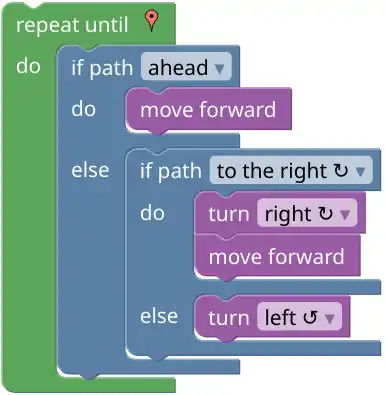
Upon clicking “Run,” the avatar moves, bound strictly by the constraints of these instructions. This mechanics demands a radical transparency of thought.
So often, we harbor the illusion of absolute comprehension. Yet, it is only when we attempt to etch our silent understanding into explicit, step-by-step algorithms that we confront the true, fragmented nature of our clarity.
Repetition: The Loom That Weaves Reality
As the architecture of the labyrinth grows more intricate, a subtle pattern emerges.
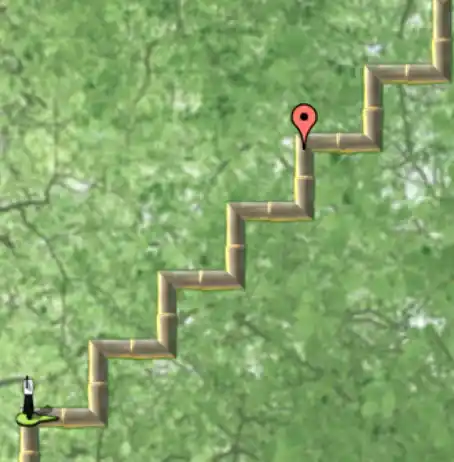
You find yourself trapped in a cadence of redundant motions. It is at this juncture that the game unveils a transformative instrument: The Loop.
Consider the contrast. Rather than dictating:
Forward
Forward
Forward
Forward
One simply commands:
Repeat 4 times:
    Forward
This is far more than a mere economy of lines; it marks the precise moment where the mind transcends the burden of detail to grasp the underlying rhythm. Here, abstract thought is born. Mathematics follows this exact trajectory of elegance.
| Level | Operation | Paradigm / Paradigm Shift | Core Conceptual Essence |
|---|---|---|---|
| 1 | Addition | $\small 2 + 4 = 6$ | The primal extension of counting |
| 2 | Multiplication | $\small 2 \times 4 = 2 + 2 + 2 + 2$ | The rhythm of iterated addition |
| 3 | Exponentiation | $\small 2^4 = 2 \times 2 \times 2 \times 2$ | The cascade of iterated multiplication |
| 4 | Tetration | $\small {^4}2 = 2^{2^{2^2}}$ | The tower of iterated exponentiation |
| 5 | Pentation | $\small {_{4}}2 = {^2}({^2}({^2}2))$ | The vertigo of iterated tetration |
| $n$ | Hyper-operation | Knuth’s Up-Arrow Notation $\small \uparrow^n$ | The infinite recursion of the $(n-1)$-th order |
Variables, functions, and formulas all converge upon a singular, poetic purpose:
To encapsulate the infinite variance of the cosmos within the briefest silhouette of information.
Seen in this light, a loop is never just a line of code.
It is kin to the variable in algebra, the law in physics, and the model in artificial intelligence—all fragments of the same mirror, reflecting the human quest to master complexity through symmetry.
The Grace of Missteps
Rare is the child who maps the perfect trajectory on their first encounter with the deeper maze. The avatar will strike walls, wander in aimless circles, or freeze in desolate corners. Thus, the player is gently forced to trace their steps back into the architecture of their own thought:
- Where did the logic fracture?
- Which premise misread the terrain?
- Where did the rhythm of iteration lose its count?
In the vernacular of tech, we call this debugging. Yet, stripped of jargon, the vast architecture of human learning is nothing but an endless, quiet process of debugging.
- The revision of a flawed mathematical proof;
- The recalibration of a failed laboratory experiment;
- The sobering adjustment of a miscalculated venture.
Learning isn’t about finding the answer all at once; it’s about continuously narrowing the margin of error. Even the delicate tapestry of human relationships follows this course. We forge constructs of the world, discover the inevitable fault lines where our understanding falters, and quietly reshape our inner models to better align with reality.
In the end, the most profound enigmas of our existence are resolved not by brute force, but through this sacred triptych: to observe with patience, to discern the hidden harmony, and to weave that harmony into an enduring tapestry of truth.