From a speck of dust to a hexagonal crystal, a snowflake is a microscopic architectural marvel masterminded by hydrogen bonds.
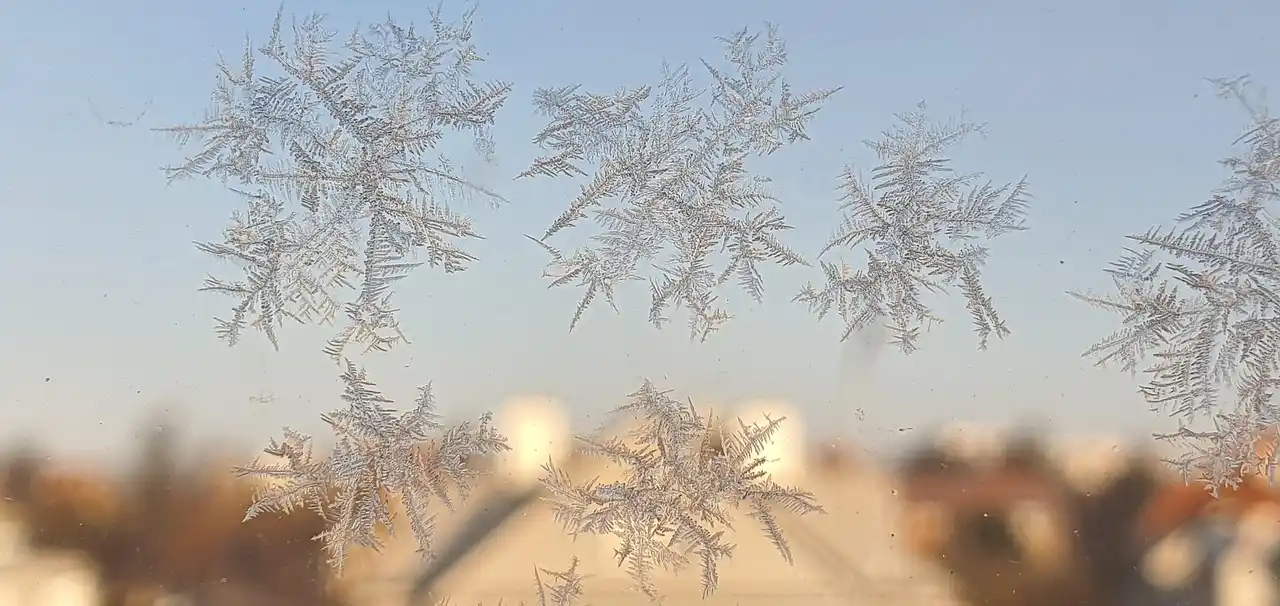
Whenever you see snowflakes drifting through the sky, have you ever wondered how these beautiful six-pointed patterns emerge from invisible water vapor? In reality, each snowflake is the result of an extraordinarily precise microscopic construction process.
Without Dust, There Would Be No Snow
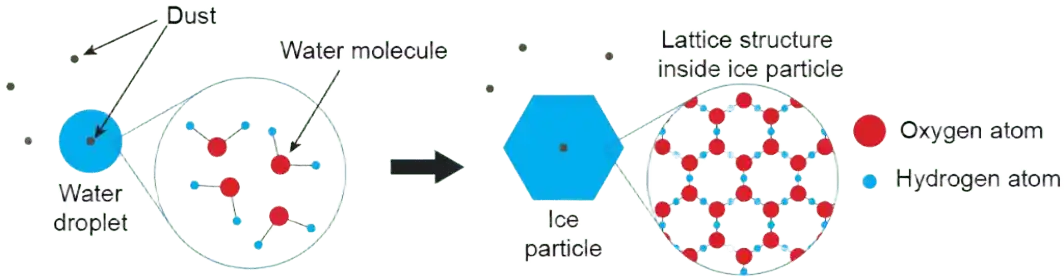
The origin of a snowflake is often not pure water, but a tiny particle of dust.
Inside clouds, when temperatures fall below freezing, water molecules in the air move chaotically in every direction. At that moment, a speck of dust acts like a “magnet” or a “foundation,” attracting nearby water molecules to settle onto its surface. This process is called ice nucleation.
- Liquid phase: At first, water molecules gather around the dust particle and form tiny droplets. In this stage, the molecules are arranged in a disordered way, constantly sliding past one another without any fixed structure.
- Transition to solid: As the temperature drops further, the water molecules begin to lose some of their freedom of movement and arrange themselves according to specific rules, forming ice crystals.
Why Hexagons?
When water freezes, its molecules do not stack randomly. Instead, they organize into a hexagonal lattice structure, similar to a honeycomb.
This is determined by the intrinsic nature of water molecules:
- The structure of water: Each molecule consists of one oxygen atom bonded to two hydrogen atoms ($H_2O$).
- The force of hydrogen bonds: In ice, the oxygen atom of each water molecule forms hydrogen bonds with neighboring hydrogen atoms. To achieve the most stable, lowest-energy arrangement, the molecules naturally organize into hexagonal rings.
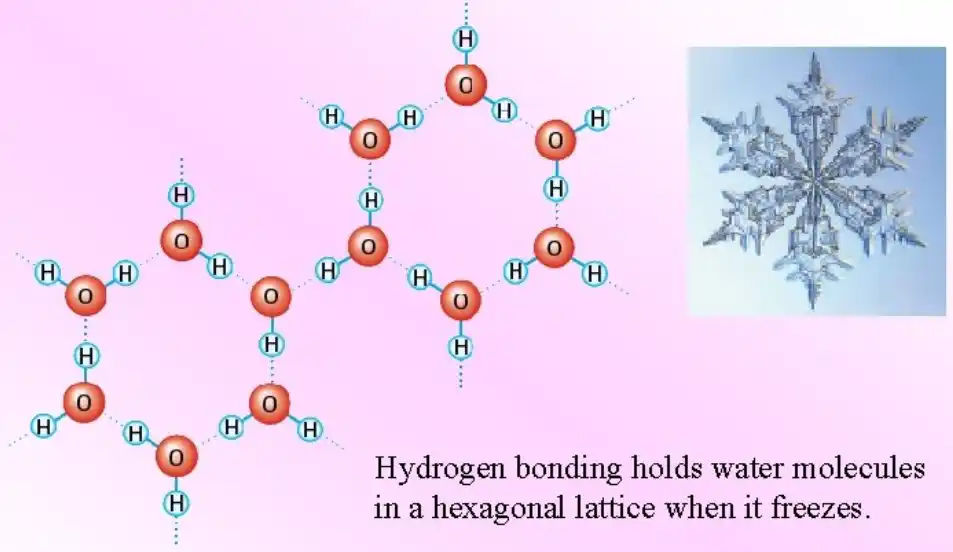
From Flat Patterns to Three-Dimensional Structures
This hexagonal arrangement does not only spread across a flat plane. It also stacks vertically in layers. Like microscopic building blocks, the molecules gradually assemble into hollow hexagonal prisms.
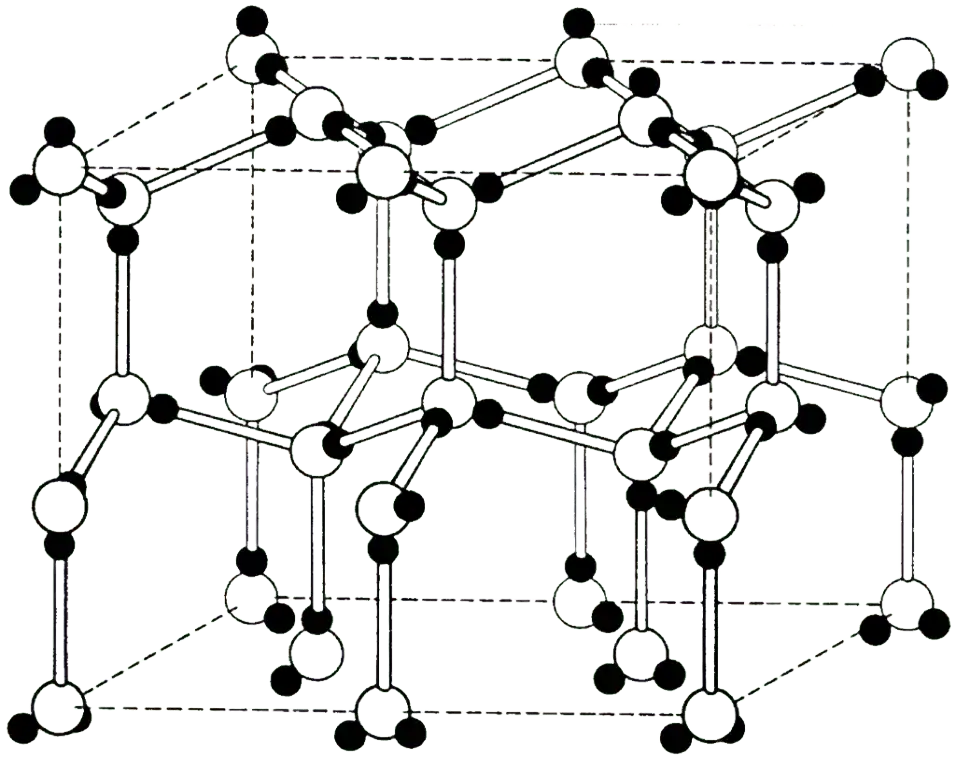
So the next time you catch a snowflake in your hand, what you are really seeing is a microscopic cathedral built by billions of water molecules under the guidance of hydrogen bonds.

Further Reading